2026 National Computer Ownership Index

A new annual benchmark for tracking the state of computer ownership in the United States, how the gap is changing, who is most affected, and where action is still needed.

How large is the gap?

IN 2024

32.9M

People in the United States lack access to a large-screen computer.

THE GAP IS MADE UP OF

7.1M

People with no computing device

Laptop with a diagonal slash indicating no computing device.

25.8M

People who rely exclusively on a smartphone

Hand holding a smartphone.

Computer access opens doors to education, better jobs, and a stronger tomorrow.

How has it changed?

2016-2024

The gap is changing, not disappearing.

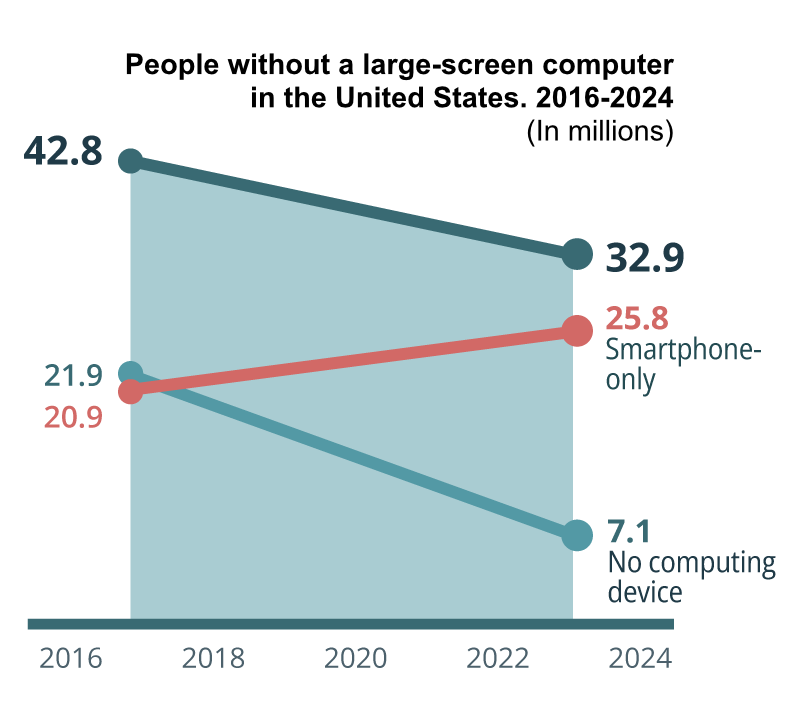
The number of people without a large-screen computer has declined from 42.8 million to 32.9 million. While the no-device population decreased, the reliance on smartphones increased. 
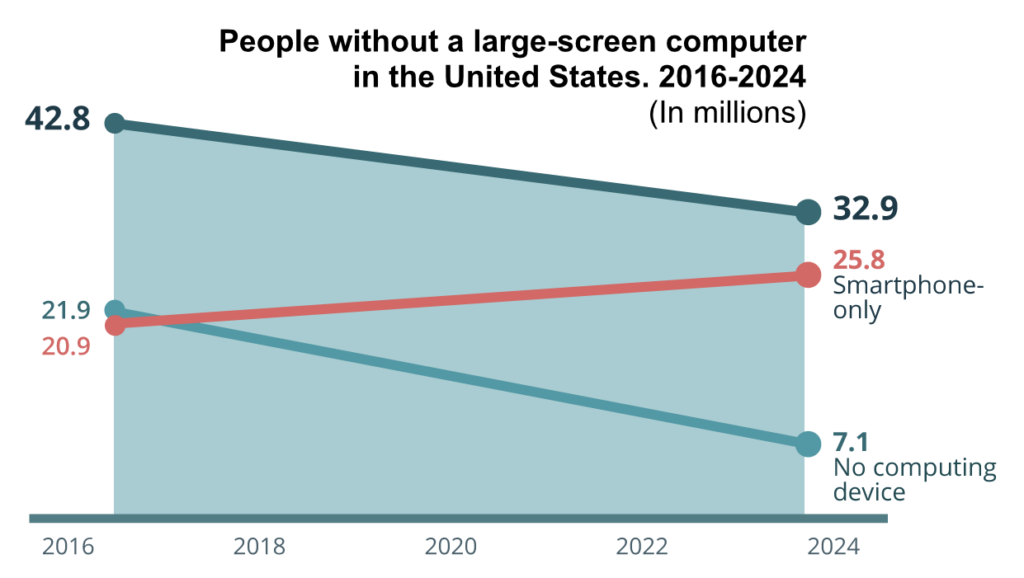
Chart showing the decline in people without a large-screen computer from 42.8 million in 2016 to 32.9 million in 2024. People with no computing device declined from 21.9 million to 7.1 million, while smartphone-only users increased from 20.9 million to 25.8 million.
Fewer people without a larger-screen computer
0 M
More people are relying on a smartphone alone, with no large screen at home
0 M
Fewer people with no computing device- the largest single shift in the data
0 M

Who experiences the largest gap?

Nearly 3 in 10 adults without a high school diploma lack a large-screen computer.

Education opens the doors to opportunity, and online access helps make it possible.

28.8%

of adults without a high school diploma

3.3%

of adults with a bachelor’s degree or higher

Where is it most pronounced?

Rural Households are more likely to lack a large-screen computer

Geography still matters. Rural households are more likely to face barriers to getting online.

16.8%

Rural Households

Illustration of a house, barn, trees, and open land representing rural households.

12.4%

Urban Households

Illustration of apartment buildings and homes representing urban households.

Labor Force

12%

of unemployed people lack a large-screen computer.

With job search, applications, interviews, and training online, computer access is essential for economic opportunity.

Older Adults

16.9%

of adults 65+ lack a large-screen computer.

Smartphone-only access among older adults rose from 4.4% in 2016 to 10.7% in 2024.

Deeper Dive

Explore the Research

Dive into the data, methodology, and additional analyses from the 2026 National Annual Computer Ownership Index.

METHODOLOGY

How the index was built and what it measures

DATA TABLES

Detailed demographic and regional data

Translate »

Data Tables

Educational Attainment (Individuals)

Methodology:

Digitunity analyzed 2024 American Community Survey (ACS) data to estimate the number and share of individuals and households that either lack any type of computing device (no desktop, laptop, smartphone or tablet) or rely exclusively on a smartphone, and therefore lack access to a large-screen computer. Household estimates are based on ACS Table S2801, combining the categories “Smartphone with no other type of computing device” and “No Computer.” Individual-level estimates and demographic breakdowns by age, educational attainment, employment status, and race and ethnicity were developed using the Census Bureau’s Microdata Access Tool (MDAT) utilizing ACS 1-Year Estimates Public Use Microdata Sample. Brian Whitacre, PhD, Professor and Chair in the Department of Agricultural Economics at Oklahoma State University, assisted in compiling and verifying the data. To assess change over time and geographic disparities, Digitunity compared 2016 ACS baseline data with 2024 ACS data for state-level and urban-rural computer access. Unless otherwise noted, “without a large-screen computer” refers to people or households with no computing device or with smartphone-only access. Population in Households refers to the number of people living in U.S. households. The individual and household level data in all tables includes information for the 50 U.S. States and the District of Columbia. 

The need for computers has never been greater.​ Sign up for our newsletter.