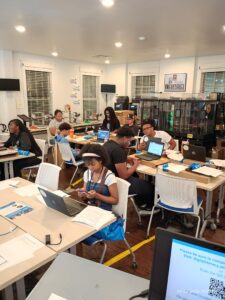
Arkansas offers a clear example of why expanding broadband infrastructure is only one part of closing the digital divide. As the state expands broadband infrastructure, leaders and community partners are also confronting the practical barriers that can keep households from benefiting from that investment.
Kamelle Gomez, Commerce Division Manager with the Arkansas Department of Commerce and Arkansas State Broadband Office, works at that intersection. His perspective connects broadband adoption, computer ownership, digital skills, and economic development, while highlighting the different roles state agencies, community organizations, colleges, workforce programs, and other partners can play in building durable pathways for Arkansas residents.
In this four-question conversation, Kamelle shares what those barriers look like on the ground, why consumer adoption matters to the outcomes broadband investments are intended to produce, and what it will take to build stronger systems around computer ownership across Arkansas.
1. As Commerce Division Manager at the Arkansas State Broadband Office, you sit at the intersection of economic development and digital opportunity. What drew you to this work, and what does it mean to you personally to be helping close the connectivity and access gap in one of the most rural states in the country?
What drew me to this work was my experiences during the pandemic and professional interest in economic development. During the pandemic, I started a role where the functions of my job went remote when in normal circumstances the activities were in person. Nearly everyday my job focused on helping low to moderate income people navigate the home ownership journey virtually. I would need to teach excited clients how to upload documents, how to create PDFs, and how to save and organize important documents. Otherwise, I have a professional interest in economic development. This role helps fulfill that with the informal skill building of digital skill frameworks.
2. What does the digital divide look like in Arkansas? Who is most impacted by the digital divide, geographically, or otherwise?
The digital divide in Arkansas looks like groups of parents and students in the library’s parking lot doing homework on a Tuesday night or soon to be mother that lives outside of the city needing to travel to take a day of from work for every prenatal visit or professionals that work remotely and who have moved back to their hometowns not being able to work due to the connection just going out randomly during the middle of the week. The digital divide mostly impacts those low to moderate income households that may struggle with affordability. There are communities in Arkansas who may not have access to reliable high speed internet as well. These compounding situations are what the digital divide looks like here.
3. Arkansas has made real progress on broadband infrastructure but you know better than most that a fiber line to the house doesn’t automatically translate into a job application submitted, a telehealth appointment kept, or a child who can do homework. From your seat at the Broadband Office, what are the barriers that infrastructure alone can’t solve and how do computers, digital skills, and local support change what’s actually possible for Arkansans?
From my seat, broadband infrastructure alone is sort of like a road or highway. Without people’s ability to afford a vehicle and their knowledge of how to navigate with it, the road itself does not provide the greatest benefit. In that same vein, fiber to the home can not produce the public good or outcomes our many federal and state broadband infrastructure programs intended to achieve without the equipment – large screen device and knowledge to navigate the online environment – digital skills. Consumer adoption is the gateway to intended outcomes. The large barrier to consumer adoption is the affordability gap. Affordability in terms of monthly service costs and costs of large screen devices and device repairs.
Another related barrier, cell phone dependency. Some people try to rely on these smaller screen devices for productivity activities in lieu of having a large screen device. Barriers to using a large screen device are barriers to internet adoption. This is a limiter of the public good these programs are looking to ultimately achieve.
4. You have been an important bridge for Digitunity in Arkansas helping open doors to potential partners and organizations across the state. Who are the players that need to be at the table for that to work? What would you say to Arkansas organizations, colleges, nonprofit organizations, workforce programs, local governments, that want to be part of the solution but are not sure where to start or what role they can play?
There needs to be an organization within our state that champions this work of getting low cost devices to low to moderate income residents and device repair. There are a lot of localized device recycling efforts focused on preventing these devices going to a landfill for an example. I am unsure of the refurbishment aspect of their work. I think we need a lot of different stakeholders with different approaches to this work. I think our universities should have some shared interest in connecting students with laptops specifically. Thinking of North Carolina’s work with their HBCU’s incoming freshmen after they studied root causes of lower than expected freshman retention rate.
For those organizations unsure of where to start, my question would be could your client benefit from a device.
Digitunity and AT&T are collaborating through the 3 Southern States Connected Communities Program to expand computer ownership, digital skills, and support across Arkansas, Louisiana, and Mississippi. The initiative will connect more than 10,000 residents to training, computers, and other resources including distributing over 2,500 donated and refurbished computers and preparing 200 digital navigators to assist residents.