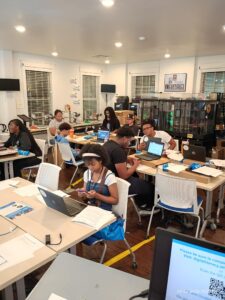
Miriam is 26 years old, a mother of a three-year-old, and a full-time manager at a wireless retail store in Eunice, Louisiana. She’s also a student, taking evening classes to earn her high school equivalency (HiSET) through VITA Lafayette, a Lafayette-based adult education nonprofit organization. And until December, she was doing it without a personal computer.
VITA, short for Volunteer Instructors Teaching Adults, recently expanded its footprint into Evangeline Parish, where Miriam and her classmates are enrolled. As more students began asking about distance learning options, the organization recognized that many lacked the computers or digital skills to participate effectively. Connecting students with computers was a natural next step.
"We were seeing more students ask about distance learning but distance learning requires a computer. This program helped us close that gap for students who work full-time, have kids, or don't have reliable transportation."
- April Porterfield, Executive Director, VITA Lafayette
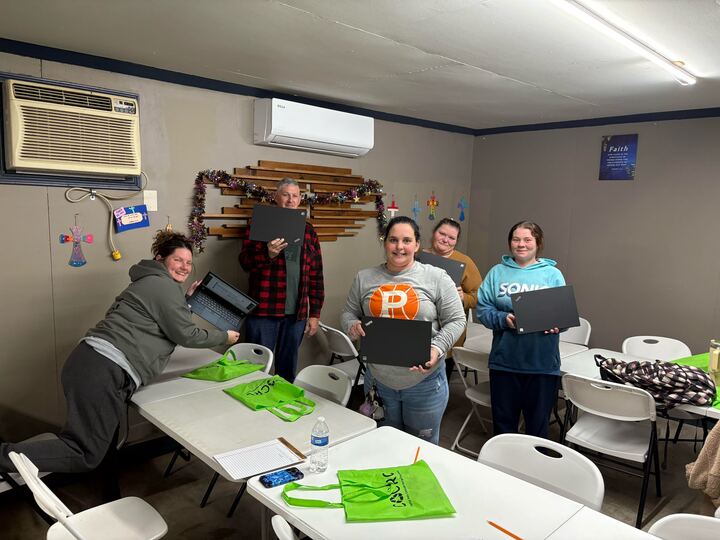
Through the 3 Southern States Connected Communities Program, a collaboration between Digitunity and AT&T, VITA distributed 50 refurbished laptops to adult learners in December 2025. Miriam was one of them.
Before the Laptop
Before receiving her laptop, Miriam did what many people do: she tried to make her phone do the work of a computer. Government websites, school assignments, anything she needed to do online — she navigated it on a small screen. But for Miriam, this went beyond inconvenience. She’s nearsighted, and straining to zoom in on fine print on a small screen held close to her face wasn’t just frustrating, it was affecting her eyesight. Having a full-size screen on her laptop has made the same tasks more accessible, more comfortable, and more sustainable for her .
Her job gave her limited access to a computer, but that was a work tool, not a personal one. At home, the laptop she received through VITA is the first computer her household has ever owned.
What a Computer Makes Possible
Miriam uses her laptop in every part of her life. At school, she completes her online HiSET coursework at her own pace, working through subject-area lessons and check-for-understanding activities. At home, she uses it to manage critical family needs: applying for Medicaid and food stamps, tasks that are technically possible to complete on a smartphone but far more difficult without a full screen.
When Miriam enrolled at VITA, she completed a Northstar digital literacy assessment, a standard part of the program designed to measure basic computer and internet skills. She scored around 90%. She credited her performance largely to her day job: years of working in wireless retail had given her real familiarity with technology, even though she hadn’t owned a personal computer. “I’m a fast learner,” she said simply. The assessment confirmed she was ready to use her new laptop effectively from day one.
Why She's Doing This
Miriam left high school in the 11th grade, just one year from graduation, to help support her family financially. Now, years later, she’s back. Not just for herself, but for her two younger sisters who are approaching high school age.
"No matter what your age, you can still finish high school," she said. She wants her sisters to see that firsthand, and she wants to make sure they don't face the same choice she had to make. "I would like to just have that in my belt, that I did finish high school," she said, "so that in case I do change careers or I want to do something more, I'll have the ability to accomplish it."
She’s also thinking about college down the road. She’s aiming to earn her high school credential by the end of this year.
A Message for Her Community
When asked what she’d want others in her community to know about the program, Miriam was direct. A lot of people avoid computers because technology feels like too much, she said. But the world is changing, and for people who are nearsighted or struggle with small text, having access to a larger screen isn’t just a convenience. It’s a matter of being able to fully participate.
“Don’t stop yourself from learning more,” she said, “and keep moving forward instead of staying on the same path. Try something new.”
As for the program itself, she hopes it expands. “I am thankful that my class, everyone in this VITA program, was given the opportunity to have a computer,” she said. Miriam hopes programs like this one will reach more people across the country so that anyone without a computer has the chance to accomplish what they want in life.
This story is part of the 3 Southern States Connected Communities Program, a collaboration between Digitunity and AT&T designed to increase computer ownership and digital skills across Arkansas, Louisiana, and Mississippi.
VITA Lafayette is a nonprofit adult literacy and education center that provides adult learners with the skills to pursue educational, vocational, and personal goals. Through this program, VITA is helping Louisiana adults access refurbished computers and the digital skills support to use them.