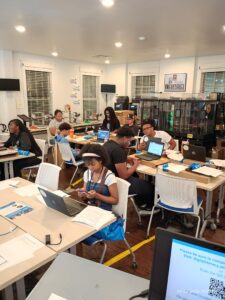
Across Arkansas, Louisiana, and Mississippi, thousands of people still lack some basic tools needed to participate fully in modern life. Although the internet is essential for education, employment, healthcare, and everyday tasks, more than one in five households in these states lack a home computer.
This creates barriers that no community should face, especially given the thousands of usable computers retiring from corporate IT cycles every year.
Today, Digitunity is calling on companies to be part of a simple, powerful solution: directing retired computers back into communities where they can open doors to learning, work, telehealth, and connection.
A Simple Shift with Big Impact
Every year, businesses refresh their laptops and desktops as part of standard IT asset management and lifecycle processes. Most of these devices still have years of useful life left, and with small adjustments to existing workflows, they can be redirected to trusted nonprofit refurbishers and community organizations.
“Businesses have the power to support local communities by making a slight change in their IT asset management practices. With each refresh cycle, a portion of decommissioned computers could instead be leveraged to help folks impacted by the digital divide. It’s a corporate social responsibility win, an environmental win, and a social impact win.”
– Scot Henley, Executive Director of Digitunity Tweet
This approach reframes computer donation as more than a one-time gesture. It becomes part of a long-term, sustainable practice that strengthens communities and reduces unnecessary e-waste.
How Digitunity Helps Companies Donate Responsibly
Digitunity’s Corporate Concierge Donation Service is designed to make participation simple, secure, and environmentally responsible. The service supports companies at every step:
- Secure handling and data safety
- Chain-of-custody transparency
- Connection to trusted nonprofit refurbishers
- Placement with community organizations in need
- Environmentally responsible reuse and recycling
This streamlined model ensures that each donated device is handled properly and given a meaningful second life.
Why This Matters Now
Computer ownership is fundamental to digital opportunity for thousands of people.
Without a reliable computer:
- Students can’t complete assignments or access digital learning
- Adults face barriers to applying for jobs or building skills necessary for the modern workforce.
- Families struggle to access telehealth, benefits, or essential services.
- Communities miss out on the long-term gains of digital participation.
A second-use computer can change what’s possible for someone, right away and for years to come.
How Companies Can Help
Donate Technology
If your business, or one you are connected to, has retired laptops or desktops available, Digitunity makes it easy to direct them where they are needed most.
Make a Contribution
Financial contributions are also welcome and help expand computer access across the South.
About the Need
According to the U.S. Census Bureau’s 2024 American Community Survey, approximately 22% of households in Arkansas, 21% in Louisiana, and 23% in Mississippi lack a desktop or laptop computer, among the highest rates in the nation.
This gap represents not just a lack of technology, but a lack of access to opportunity.
Digitunity is committed to changing that by connecting the power of corporate IT refresh cycles with the communities that benefit most from them.
About Digitunity
Digitunity is a national nonprofit working to make computer ownership possible for everyone. Through partnerships with corporations, community organizations, and government agencies, Digitunity connects donated technology with people and programs that need it most.