Expanding Computer Ownership in Mississippi: A Conversation with Yolanda Wooten, Canopy Children’s Solutions

Digitunity recently sat down with Yolanda Wooten, the LINK Director at Canopy Children’s Solutions, an organization dedicated to providing behavioral health, education, and family support services for underserved families across Mississippi. Canopy Children’s Solutions has served approximately 2,800 children through behavioral health solutions and 1,300 children through educational services. Canopy Children’s Solutions has reached over 7,500 children and their families through family support solutions. LINK connects Mississippi families with children to available support and local, state, and federal resources aimed at building stronger, healthier relationships.

In recent years, a pattern emerged through Canopy Children’s Solutions social needs screenings. Most of the families they serve do not have a computer at home. In a moment when education and healthcare have moved online, this absence was a structural barrier to much needed services. Without a device, families couldn’t access virtual admissions, telehealth appointments, or therapy sessions, essential services for Mississippi residents.

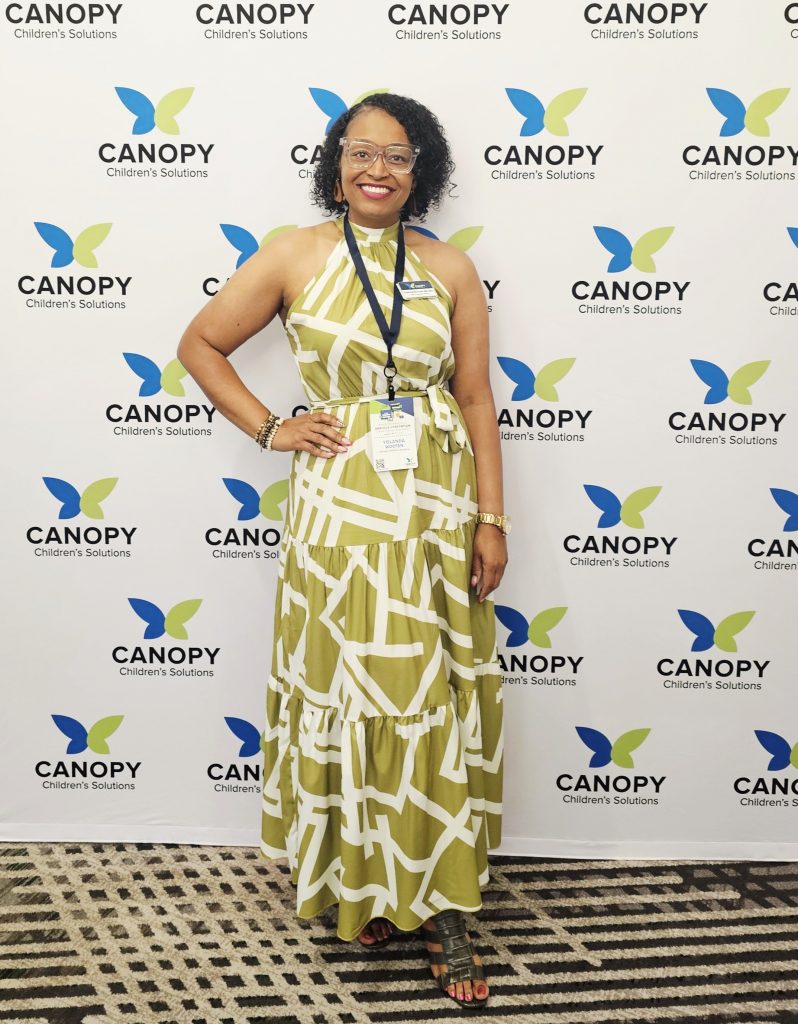
Canopy Children’s Solutions staff member smiles while standing in front of a branded Canopy event backdrop.

The numbers reflect what Canopy Children’s Solutions was seeing on the ground. According to 2024 Census Bureau data, there are 89,582 individuals in Mississippi who don’t have access to any type of device and 405,235 people who rely exclusively on smartphones to go online. In sum, there are approximately 495,000 Mississippi residents who don’t have access to computers, representing 17.4% of the state’s population. Mississippi has the highest percentage of households without a computer in the nation (22.8%) with nearly 1 in 4 homes not having access to a device. 

The state-level figures obscure deeper regional disparities with rural communities in the Delta region facing the biggest hardships. An analysis of 2020-2024 5-Year American Community Survey data for all Mississippi counties shows that in certain counties, half of homes don’t have access to a computer.

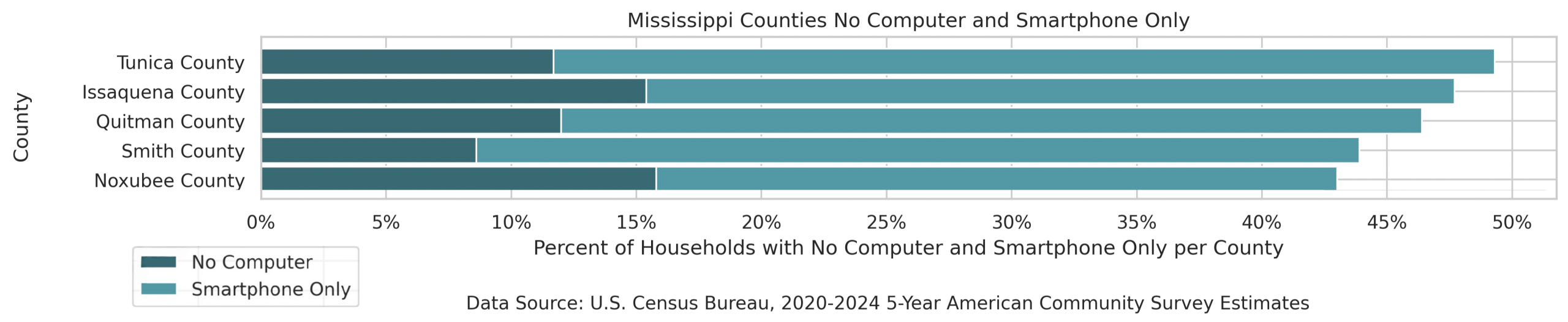
The counties with the highest rates of households without computers or relying solely on smartphones are:

Graph showing the counties with the highest rates of households without computers or relying solely on smartphones in Mississippi: Tunica County at 49.3%, Issaquena County at 47.7%, Quitman County at 46.4%, Smith County at 43.9%, Noxubee County at 43.0%
  • Tunica County at 49.3%
  • Issaquena County at 47.7%
  • Quitman County at 46.4%
  • Smith County at 43.9%
  • Noxubee County at 43.0%

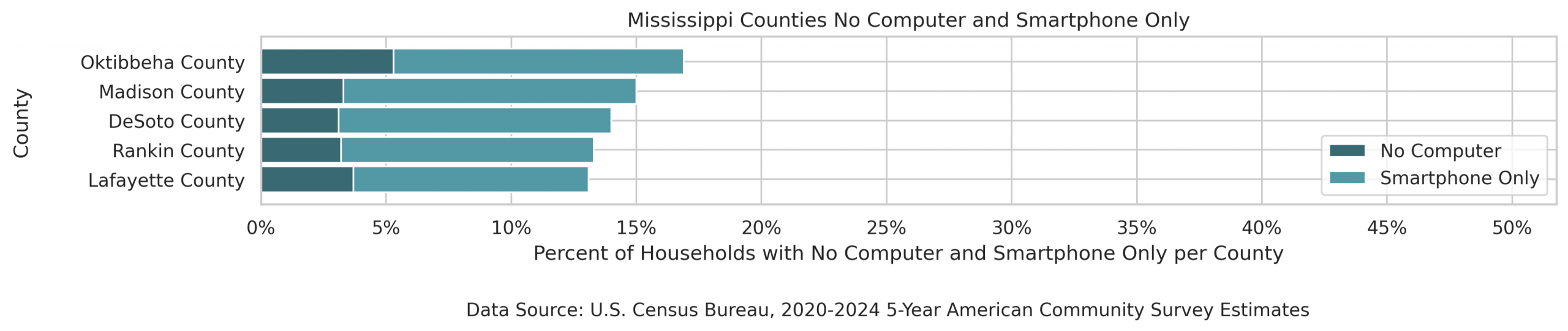
Even in counties where the fewer homes lack devices, more than 13% of households still don’t have reliable access to computers and are smartphone reliant. 

Graph showing the counties with the lowest rates of households without computers or relying solely on smartphones in Mississippi:Lafayette County at 13.1%, Rankin County at 13.3%, DeSoto County at 14.0%, Madison County at 15.0%, Oktibbeha County at 16.9%
  • Lafayette County at 13.1%
  • Rankin County at 13.3%
  • DeSoto County at 14.0%
  • Madison County at 15.0%
  • Oktibbeha County at 16.9%

Computer Ownership as a Starting Point

A collaboration among AT&T, Digitunity, and Canopy Children’s Solutions is making a major difference for hundreds of families across Mississippi since early 2025. The current project is part of the 3 Southern States Connected Communities Program, which pairs computer ownership with digital skills training and gives families the tools and knowledge to use them. Since December 2025, Canopy Children’s Solutions has reached 109 community members through digital skills workshops offered across seven locations in Mississippi. Since the start of the partnership, 499 free refurbished computers have been provided to Canopy Children’s Solutions for distribution to families who previously did not have a device. 

To receive a computer, participants commit to attending three digital literacy workshops. These sessions meet families where they are. Classes are held in libraries, schools, and health alliance offices across seven satellite locations. For families facing disability or transportation hurdles, Canopy Children’s Solutions “boots on the ground” staff conduct one-on-one training directly in the home or provide transportation to classes. 

The curriculum starts with the basics, ensuring no one feels left behind. “We don’t assume they know how to turn on the computer,” Yolanda explains. As participants gain confidence, the lessons evolve to cover internet safety, email creation, and video-conferencing basics.

The Grandmother Who Became a Community Ambassador for Digital Skills

The impact of these workshops builds community. Yolanda recalls one particular participant who arrived at a workshop to learn how to better support the grandchildren she was raising.

After completing her required sessions and receiving her computer, she stayed on and helped classes as a volunteer and an ambassador for digital skills. Inspired by her own journey to digital literacy, she now spends her time passing out materials and helping other participants navigate their first steps into the digital world.

What Ownership Makes Possible

When families  own a computer, the benefits are immediate:

  • Healthcare Access: Families can now attend virtual Applied Behavior Analysis (ABA) therapy and family team meetings via Microsoft Teams, saving significant time and money on travel.
  • Education: Children who miss school can stay caught up via virtual sessions, and parents can finish online degree programs. Yolanda shared the story of one participant who was able to complete her Certified Nursing Assistant (CNA) classes and secure a remote job—all while caring for her toddler at home.
  • Stability: Individuals with disabilities are finding new pathways to employment through work-from-home opportunities that were previously out of reach. Families with transportation barriers can enjoy better economic and educational participation as well as opportunities to seek support through the variety of behavioral health, education, and family support solutions available at Canopy Children’s Solutions.

What it Will Take to Reach Everyone

The challenge remains significant, particularly in the Mississippi Delta, where computer affordability, transportation challenges, and the lack of publicly available devices in libraries and schools are major impediments to closing the digital divide. The work of Canopy Children’s Solutions focuses on addressing the needs of community members by linking computer access and digital skills to better health and education outcomes for families can serve as a model for other organizations.

In the words of one digital literacy participant, cost is a major barrier to computer ownership.

“I have not had a laptop for 15 years, this class and opportunity to refresh my knowledge and learn new things is going to help me a lot. I have also been going to the library for so many years, because we have not been able to afford a computer or laptop. I am beyond grateful to Canopy Children’s Solutions and everyone who helped put everything together so wonderfully. My family is beyond words for everything received and the kindness and warm hearts from all of the staff.” 

In the words of another participant, having a computer at home has many benefits.

“This laptop means a lot to me. I used to have one, but it eventually became so slow that it was basically unusable. Having this new one will help me be more productive, which means a lot to me as a parent.”

Canopy Children’s Solutions celebrates each family’s journey as they gain the tools and knowledge to fully participate in a world that runs on technology.  For Yolanda and her team, each “mission moment”, a graduation, a new job, or a successful telehealth appointment, is evidence of what becomes possible when a family owns a computer and skills to act on their own opportunities.  

This story is part of the 3 Southern States Connected Communities Program, a collaboration between Digitunity and AT&T, designed to increase computer ownership and digital skills across Arkansas, Louisiana, and Mississippi. Through this program Canopy Children’s Solutions helps Mississippi residents access refurbished computers, digital skills training, and one-on-one support from trained digital navigators. This program enables residents to use technology for education, employment, health and daily life.

About Digitunity

Digitunity is a national nonprofit organization making computer ownership possible for everyone. For more than 40 years, Digitunity has worked to close the digital divide in the United States by shaping and strengthening systems that make computer ownership possible. Digitunity sources and places computers with a network of over 1,600 community-based organizations, supports digital skills programs, and provides strategic advisory services to states and cities. With 1 in 7 U.S. households lacking a computer at home, this national-local approach mobilizes resources, influences policy, and builds durable solutions that expand opportunity, participation, and economic mobility. Learn more at digitunity.org.

About Philanthropy at AT&T

At AT&T, our corporate responsibility work is dedicated to bridging the digital divide across the country. We are committed to providing people of all ages and from every community with the essential resources they need to thrive in the digital era. For generations, we have supported programs that impact millions of individuals nationwide, and since 2021, we have committed $5 billion to initiatives that enhance connectivity, promote digital literacy, and improve access to high-speed internet. Our efforts particularly focus on uplifting underserved communities, including students, older adults, and un- or underemployed individuals, ensuring everyone can participate in the digital world and benefit from its opportunities.

Other Recent Posts

Black-and-white portrait of a woman wearing a cowboy hat, patterned glasses, and a light-colored jacket while smiling and adjusting the brim of her hat indoors.

Lifelong Learner: Ms. Gales’ Digital Journey

Ms. Brenda Gales spent decades teaching kindergartners how to learn. In retirement, she found that she was now the learner as the digital world continuously moves ahead. Laptops, unfamiliar interfaces, complex software: she manages her iPhone well, but other technologies started feeling out of reach. When a former classmate from high school told her about the Connected Learning digital literacy workshops offered by Canopy Children’s Solutions in collaboration with Digitunity and AT&T, Ms. Gales didn’t

Graphic promoting a Digitunity report titled “AI Workforce Investments Risk Falling Short Without Computer Ownership.” The image shows the report cover alongside the text “Download the Report” and states that more than 32.9 million Americans lack a computer at home, limiting participation in AI-driven education and workforce programs.

New Report: AI Workforce Investments Risk Falling Short Without Computer Ownership

A new analysis on why policy momentum requires stronger implementation systems We believe the nation’s ability to compete in an AI-driven economy depends on building skills at scale. Federal agencies, state leaders, and workforce systems are moving quickly to expand AI education and training. While policy momentum is clear, the underlying infrastructure necessary for implementation has failed to keep pace. AI literacy is not achieved through a single session or a short-term course; it requires

Hand on a steering wheel driving down an open highway through a desert landscape with mountains in the distance.

How Philanthropy Can Fund Truly Inclusive AI

Scot Henley Executive Director at Digitunity “Inclusive AI” is everywhere in philanthropy right now. I want to talk about what it actually means, and what funders are missing. First, let’s state what is true and obvious. Major philanthropic funders play a vital role in society, deploying vast resources to address problems large and small, at home and abroad. As the adoption and capability of AI races forward at breathtaking speed, philanthropy has mobilized to tackle

Translate »

The need for computers has never been greater.​ Sign up for our newsletter.