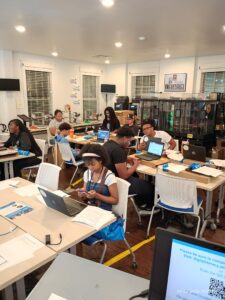
It was quite an honor to have been invited to participate in this week’s Good Tech Fest, an intimate gathering of some of the nation’s most important “tech for good” figures from the tech sector, tech-focused philanthropy, intermediaries, and nonprofits from the tech arena. I came home with my “bucket” filled, batteries recharged, a fire in my belly, and a new tribe of like-minded people to collaborate with and learn from.
The event, hosted high in Utah’s Wasatch Mountains at Sundance Resort, was designed for leaders to come together to discuss how emerging technology is driving impact in the social sector and identify opportunities for collaboration. And it delivered on that promise.
Instead of the typical jam-packed conference schedule and content overload, the agenda was designed with built-in intentional space to foster meaningful conversations, whether they take place over coffee, around a fire, at dinner, or on a hiking trail. So many meaningful and generative conversations were had during these moments.
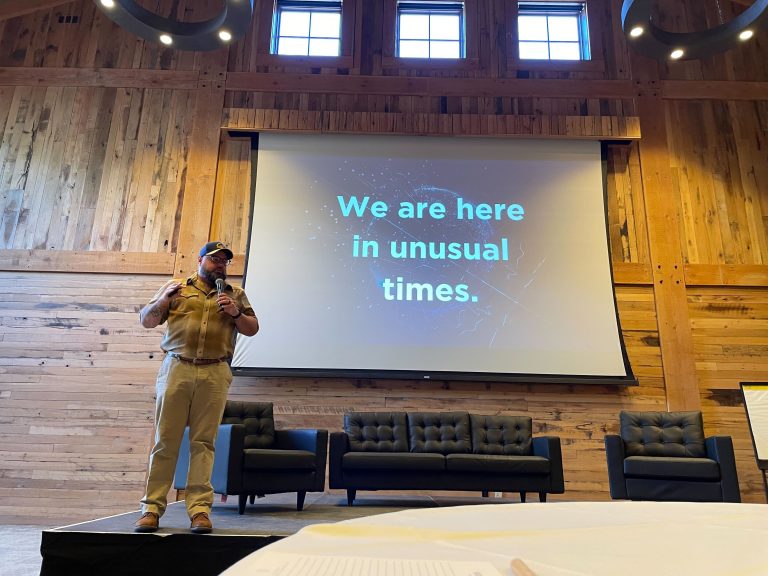
The current political environment and the very real threats faced by the nonprofit sector were certainly present; being honest, how could they not be? We were, as the photo shows, all gathered together during these “unusual times.” However, Good Tech Fest was focused on the good and the action required to combat the bad.
As a field catalyst addressing the digital divide, Digitunity works at the systems level to help expand computer ownership. One in seven households in the U.S. still lacks a large-screen computer. It is our firm belief that solving that problem requires more than short-term fixes; it requires reshaping the systems that leave so many people behind.
We are not alone in systems thinking. Good Tech Fest included multiple sessions and meaty discussions about the power and impact of collaborative systems. One particular session related networks of organizations working together to solve complex social issues to the largest living organism on Earth. “Pando” is the scientific name for a massive quaking aspen clone in Utah’s Fishlake National Forest, a single tree spanning over 100 acres with over 40,000 stems, all connected by a vast root system. No single stem dominates the tree, no trunk outgrows the rest– the entire thing is fed and supported by this giant root system. It thrives because it is interconnected.
There is no monolithic solution to complex problems; they often require a robust “root system” of contributors. Conference presenters acknowledged the changing nature of social impact work, and noted that “the era of the large individual organization scaling their solution as the ‘best’ answer to a problem is over.” Root systems must be developed to underpin and feed all the growth above.
That’s what our work demands. Real solutions grow from robust root systems that draw on the greatest strengths of many contributors. In our consulting practice, we help our clients (and the field) do just that: tap trusted community assets, build shared infrastructure, and tailor strategies to support the unique technology needs of residents.
I’m grateful for having had the opportunity to be in such a thoughtful, inspiring space with amazing people who are genuinely interested in using tech to make the world a better place. After several memorable days of thought-provoking conversations, connection, and clarity, I like our chances.
Authored by Scot Henley, Executive Director of Digitunity.