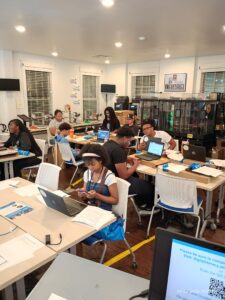
AI literacy is becoming a growing federal workforce and education priority, but one practical gap remains unaddressed. Today, 32.9 million people still lack the computer access required to develop these skills.
At Digitunity, we believe AI literacy cannot be achieved without computer ownership.
Federal policy frameworks from the Department of Labor, the Department of Education, and the White House increasingly recognize that device access is essential to AI literacy program design. However, these policies often refer to “devices” broadly, without defining what kind of device is needed for meaningful participation, and that distinction matters.
Our policy statement argues that a personal computer enables sustained AI skill development. Smartphones can support basic online access, but they are not enough for the education and workforce tasks AI literacy requires, including applications, research, document creation, prompt development, and evaluating AI outputs. Without a personal computer, many learners and workers are left without the tools needed to fully participate in AI learning and career opportunities.
Our Policy Recommendations
To close the gap between federal AI literacy goals and the infrastructure needed to achieve them, we recommend that federal, state, and local leaders:
- Establish pathways for the transfer, donation, refurbishment, and community deployment of surplus and retired government and corporate technology to increase the supply of reliable, free, and low-cost computers.
- Fund and integrate computer ownership into AI literacy, workforce, and education programs, ensuring learners have computers to keep at no or low cost.
- Require computer ownership status as a data element in intake forms for publicly funded education and workforce programs, so gaps are visible and addressable at the program level.
- Measure and report outcomes for participants in publicly funded programs who receive computers and AI literacy training, including credential attainment, career advancement, and wage growth.
AI literacy policy is moving quickly, but policy momentum must be matched by implementation systems that give learners and workers the tools to participate. For more on this issue, read Scot Henley’s perspective on inclusive AI and our analysis of why AI workforce investments depend on computer ownership.
Explore More on AI

How Philanthropy Can Fund Truly Inclusive AI
What Funders Are Missing About “Inclusive AI”
In this perspective piece, Digitunity Executive Director Scot Henley explains why inclusive AI must begin with computer ownership, agency, and systems-level change.

AI Workforce Investments Risk Falling Short Without Computer Ownership
AI Workforce Investments Risk Falling Short Without Computer Ownership
This analysis explores why federal AI policy momentum must be matched by implementation systems that include sustained computer ownership.