Scot Henley
Executive Director at Digitunity
“Inclusive AI” is everywhere in philanthropy right now. I want to talk about what it actually means, and what funders are missing.
First, let’s state what is true and obvious. Major philanthropic funders play a vital role in society, deploying vast resources to address problems large and small, at home and abroad. As the adoption and capability of AI races forward at breathtaking speed, philanthropy has mobilized to tackle many related challenges and concerns. No doubt, there is good intent behind such efforts and grantees are and will continue doing important work.
There are efforts underway to address the risks and safety of AI, the governance of AI, the ethics of AI, and AI’s societal impact. Then there are specific use cases of AI in research, climate modeling, global health, education, government services, civil liberties, policy, democracy, arts and culture, and many more.
A growing number of individual philanthropies are adding AI to their portfolios. Coalitions of funders have assembled and pooled resources to address specific aspects of AI. AI conferences are being hosted. AI articles are being written. My inbox is full of newsletters touting visionary AI programs with inspiring AI goals, and my LinkedIn feed is all AI, all the time.
There’s a whole new language around AI that has sprouted. “AI for Humanity,” “People-First AI,” People-Centered AI,” and so on. In the nonprofit space, much like across practically all sectors, AI is everywhere.
A term that recently stopped me in my tracks is this one: “Inclusive AI.”
To me, inclusive AI registers as a virtuous, lofty goal; everyone should have the ability to benefit from the power and promise of AI. But how does one individually benefit? Are the benefits of AI bestowed upon all of us, or should all of us have the ability to individually benefit? There’s nuance in there.
Inclusive AI is about agency. It’s about self-determination. It’s the difference between being behind the wheel or stuck in the back seat. Sure, the AI hot rod is going places, but can each of us individually drive that hot rod where we want it to go?
In my view, that’s where philanthropy must play an active, intentional role.
A recent Digitunity review of U.S. Census data shows that one-in-seven households in the United States lack a home computer. That equates to nearly 33 million people, roughly one tenth of our entire population.

Without a computer, 10% of people in the U.S. don’t develop digital skills. They don’t build AI literacy. And they don’t get to participate in technology that is reshaping every aspect of life. They are buckled in as a passenger; along for a ride they didn’t choose and can’t steer. That is not inclusive AI. That’s AI happening to people.
The gap in computer ownership is a systems problem. The current systems that enable computer ownership work fine for 90% of the population, yet leave 10% behind. There are enough computers in circulation across government, industry, offices, and households to eliminate that gap many times over. The solution requires changes to policies, practices, narratives, and incentives surrounding how IT assets are treated at the end of their first use.
Addressing this core aspect of the digital divide, an inherently solvable problem, will enable the full meaning of inclusive AI. That requires financial resources, coordination, and intention.
No single funder, policy, program, or organization has the capacity to single-handedly eliminate the computer ownership gap. To chart the way forward, Digitunity will soon release a comprehensive theory of change intended to provide a framework for a durable solution.
To enable truly inclusive AI and ensure people have the agency, tools, and capability to drive it themselves, this is where philanthropy has a tremendous opportunity to step in. It’s not about spinning up one-off computer distribution programs, it’s about change at scale. Philanthropy holds the keys to that hot rod.
If the term “inclusive AI” is going to mean anything, this is where it starts.
This article was originally published on LinkedIn.
Explore More on AI
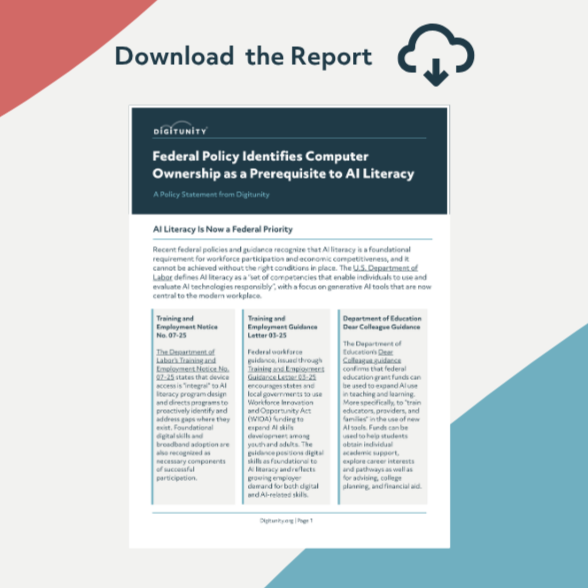
Computer Ownership Is a Prerequisite for AI Literacy
As AI literacy becomes a growing federal priority, computer ownership must be part of the implementation strategy. Digitunity’s policy statement explains why personal computers are essential to sustained AI skill development and offers recommendations to close the gap between policy goals and meaningful participation.

AI Workforce Investments Risk Falling Short Without Computer Ownership
AI Workforce Investments Risk Falling Short Without Computer Ownership
This analysis explores why federal AI policy momentum must be matched by implementation systems that include sustained computer ownership.