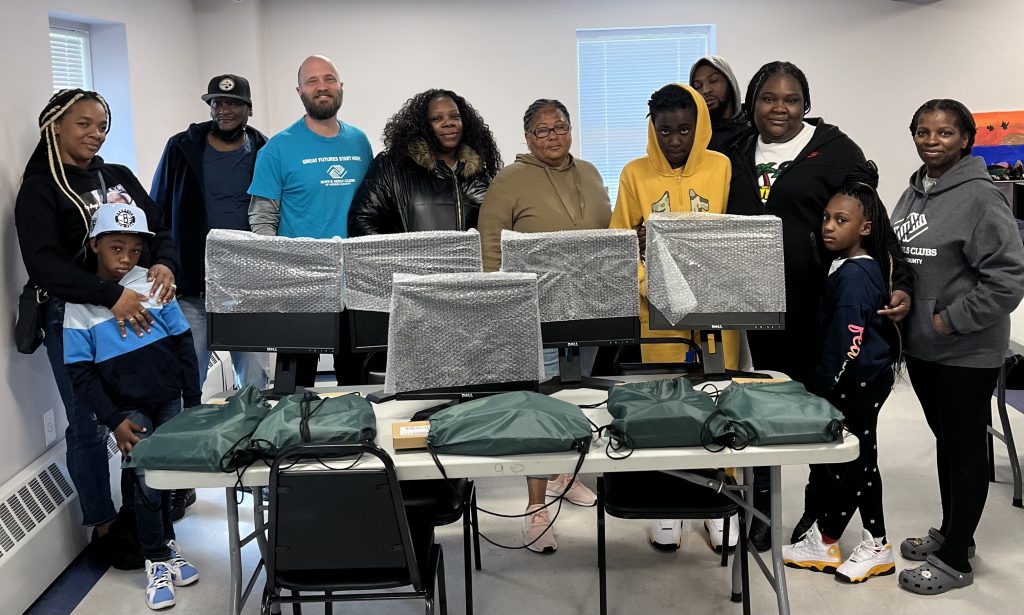
Young Jersey City Housing Authority residents receive donations of computers, vital for education, at a public event at the Booker T. Washington public housing development.
Digitunity and the Jersey City Housing Authority gave 75 computers to young people who need them for their education, in a public event on Thursday, July 28, at the Booker T. Washington housing development in Jersey City, New Jersey. In total, over 300 computers will be provided to JCHA youth over the next year.
The event is one of several distributions in the New York City area for Digitunity, a national nonprofit organization that closes the technology gap by connecting low-income people with the computers they need. Digitunity believes access to a computer at home has become vital for people to succeed both in school and economically.
In today's education system, children need a computer in their home to do research and run the applications they need for homework and projects. Yet, one-third of Black and Hispanic households don't have that resource.
Providing these computers helps close the digital divide. That is Digitunity's mission. We're thrilled to partner with the Jersey City Housing Authority and Electronic Access Foundation to help these young people.
Scot Henley, Executive Director, Digitunity Tweet
The Electronic Access Foundation is a nonprofit organization and Digitunity partner that obtains surplus electronic equipment from corporations, universities, and other groups and donates them to other qualified charitable organizations.
The Jersey City Housing Authority (JCHA), created in 1938, provides affordable housing for low-income families, seniors, and people with disabilities. It administers about 7,100 housing units, home to over 15,000 people. JCHA administrators thank both groups for their support.
Digitunity and our local partner, Electronic Access Foundation, have played an essential role in the development of JCHA's digital inclusion initiatives since 2019.
Vivian Brady-Phillips, Executive Director, Jersey City Housing Authority Tweet
Through donations of refurbished computers, EAF has provided computers that enabled JCHA to develop on-site computer labs at four of our public housing developments and provided computers directly to families. With these resources, JCHA leverages local nonprofit partnerships to host digital literacy classes and provide computer access to residents without devices at home.
This latest initiative with AT&T will allow nearly 300 of its youngest residents in-home computers to truly access a 21st-century education. A portion of the computer donations will be distributed to JCHA youth who attend the Boys and Girls Clubs of Hudson County. Jersey City Mayor Steven M. Fullop said the initiative was another example of how the city employs creative approaches to assist its citizens.
In Jersey City, we've taken innovative approaches to expand opportunities for all residents, with a focus on eliminating the socioeconomic barriers disproportionately impacting communities of color.
From promoting homeownership and self-sufficiency, to place-based community programs that support children and seniors, provide vital resources and create powerful partnerships that deliver results, including this latest initiative.
The work we're doing together today will impact residents for generations to come. We want to get local businesses involved in donating used computers to support digital access for low-income families.
Mayor Steven M. Fullop, Jersey City Tweet
To learn more about Digitunity’s mission to end the digital divide, please visit Digitunity.org.