Device Ownership Matters

hands on laptop keyboard with title

Access to large-screen computing devices (e.g. laptops, desktops) is essential to protect against the creation of a second class digital citizen.

Digitunity commissioned leading expert Amy Gonzales, an Associate Professor of the Department of Communication at the University of California, Santa Barbara, to examine the importance of large screen device ownership and the impact that disparities in ownership by race and income have between groups of people, especially those in marginalized groups.

This original report provides an evidenced-based discussion for why access to large-screen computing devices (e.g. laptops, desktops) is essential to protect against the creation of a second class digital citizen, and provides five recommendations on how to close the digital divide nationwide.

The way out of the digital divide must include scalable solutions that provide a lasting pathway to large-screen device ownership and ongoing support so that everyone who needs a computer can have one. 

Register below and click the download button to be sent a PDF copy of the report.

Download the Device Ownership Matters: The Importance of Large-Screen Device Ownership Report.
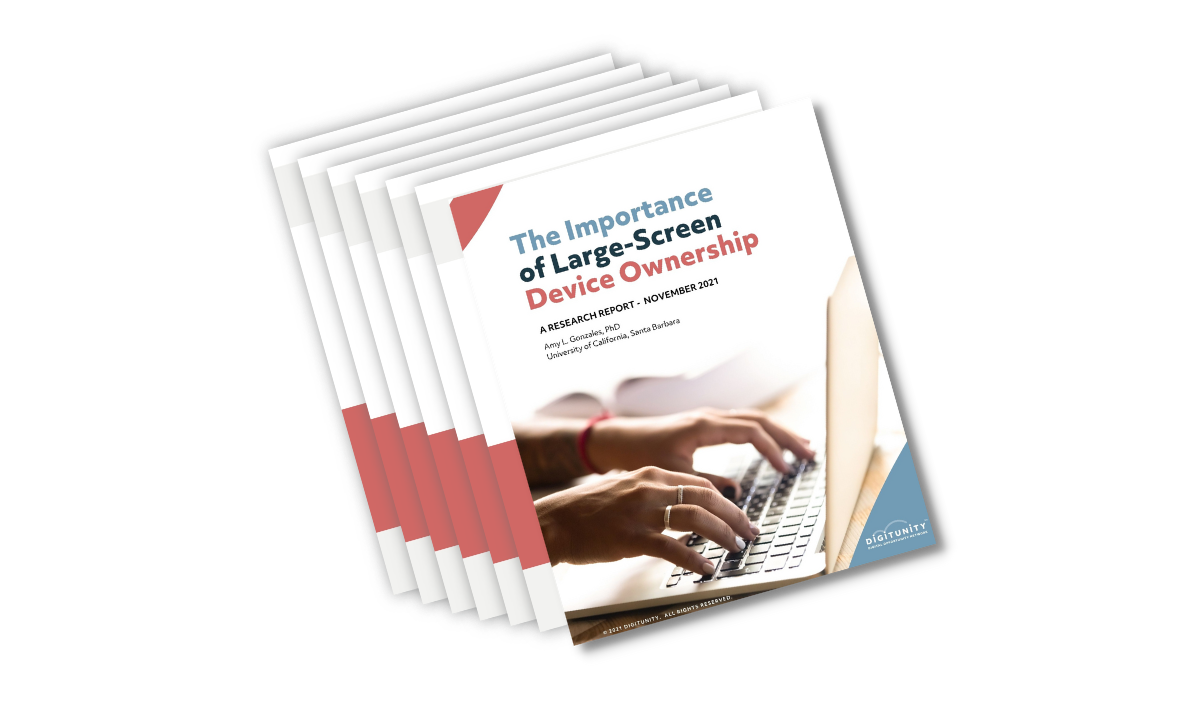
device ownership matters report mock up

Other Recent Posts

A man wearing a maroon polo shirt and an "Oklahoma" baseball cap sits at a wooden desk using a computer with a spreadsheet open on it.

Digital Skills in Action: From Training to the Workplace

At Hope House Guthrie, rebuilding a life often begins with learning new skills. Hope House Guthrie is a nonprofit in Guthrie, Oklahoma, that provides shelter, meals, and clothing to individuals experiencing homelessness and hardship. The organization also connects people to resources that support recovery, employment, and long-term stability. For many people entering recovery and life transformation programs, rebuilding their lives means gaining work experience, reconnecting with their community, and learning ways to navigate systems that

Cover image of Digitunity report on smartphone-only access and its limits in program design and policy.

The Smartphone-Only Assumption

Why device access shapes participation in modern systems A new analysis from Digitunity examines a common assumption in program design and policy: that smartphone access is enough. This analysis shows where that assumption breaks down. While smartphones are widely used and effective for communication and quick tasks, they are not designed for the kinds of activities required to fully participate in modern systems, such as education, employment, healthcare, and public services. In the United States,

A man stands in front of a green CACRC backdrop, holding an open laptop and smiling, dressed in a black polo and sneakers.

How One Louisiana Nonprofit is Strengthening Computer Ownership Across the Gulf South

In Louisiana, a non-profit technology refurbisher addresses an overlooked digital divide by giving computers a second life and a second home. The computer ownership gap across Arkansas, Louisiana, and Mississippi is among the deepest in the nation. In these Southern states, 2024 American Community Survey data shows that 1 in 5 households or a total of 929,620 households, did not have access to a computer or relied solely on a smartphone for their internet connectivity.

Translate »

The need for computers has never been greater.​ Sign up for our newsletter.