Introduction
Access to reliable computers is essential for education, work, healthcare, and opportunity in rural America. Yet, approximately 14% of U.S. households still lack a desktop or laptop computer, with many relying solely on smartphones, which limits digital skill growth and access.
Supportive and Sustainable Device Ecosystems for Rural America, authored by Brian Whitacre (Oklahoma State University) and supported by Digitunity and AT&T, offers actionable strategies and real-world lessons from a 15-month initiative with partners in Mississippi and Arizona.
Key Data & Insights: Rural Digital Access at a Glance
Rural Computer and Internet Access—By the Numbers
- ~14% of U.S. households (2023) have no desktop or laptop at home
- 10% are “smartphone dependent”, relying only on smartphones for online access
- 4% have no computing device at all
What You’ll Learn
- Key barriers to computer ownership in rural America
- Strategies for building local device ecosystems
- How partnerships and field catalysts drive change
- Best practices in computer supply, deployment, and digital skills training
- Case studies and success stories from the field
- Practical resources for local implementation
Report Highlights
What’s in the Report
- 20 actionable takeaways for building sustainable computer ownership ecosystems in rural America
- Proven models for community partnership building, deployment best practices, and local catalyst engagement
- Field-tested strategies for device supply, reliable deployment, and ongoing digital skills training
- Guidance for engaging state broadband offices, aligning with federal and state digital equity plans, and evaluating impact
- Real-world case studies and survey data on device utilization and community impact
Outcomes & Recommendations
This report is structured around five outcomes critical for rural digital access:
- Building awareness of local computer needs
- Developing mutually beneficial relationships with donors and suppliers
- Formalizing device deployment practices
- Implementing digital skills training
- Sustaining and scaling community-led device ecosystems
About the Authors & Partners
This report is a collaboration between Brian Whitacre (Oklahoma State University), Digitunity, and AT&T. The project engaged local partners, including Chicanos Por La Causa, Arizona Students Recycling Used Technology (AZStRUT), Mississippi Broadband Association, community colleges, and a network of nonprofit and business leaders.
Download the Report
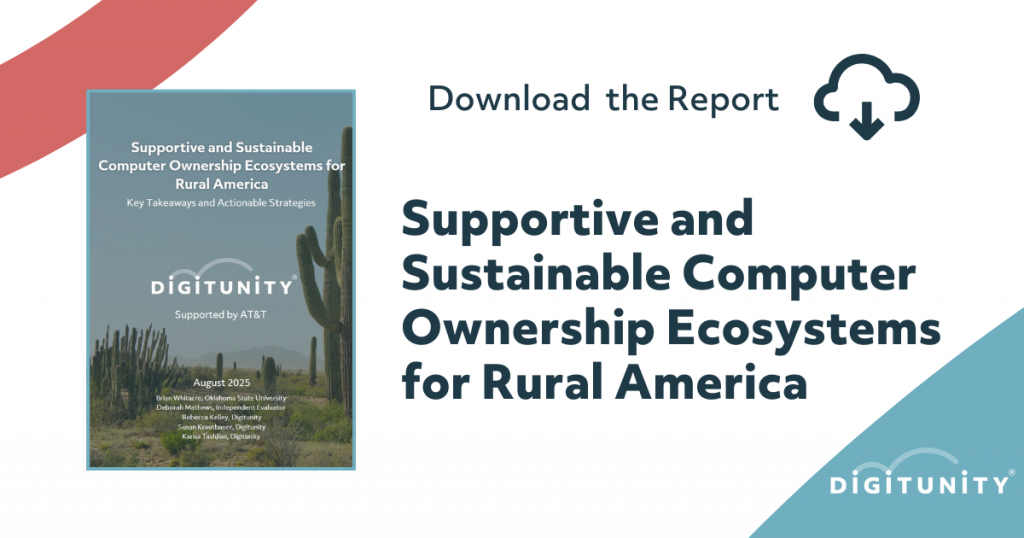
To share deeper key findings and insights, Digitunity will host a webinar with report author Brian Whitacre. The event will highlight the results of the initiative, demonstrate how to develop a sustainable device ecosystem, and discuss the critical role of local catalysts. The webinar will take place on September 10th at 1PM ET.
FAQ
Who should download this report?
Community organizations, digital opportunity practitioners, funders, and rural leaders seeking practical guidance and inspiration to expand computer ownership.
What is a sustainable device ecosystem?
A local system that ensures a reliable supply of quality computers, effective deployment to residents, and digital skills training, supported by trusted partnerships and continuous learning.
How can I use this report?
Apply the strategies, workflows, and resources to your own community or organization. Share with partners and adapt the templates for your local context.