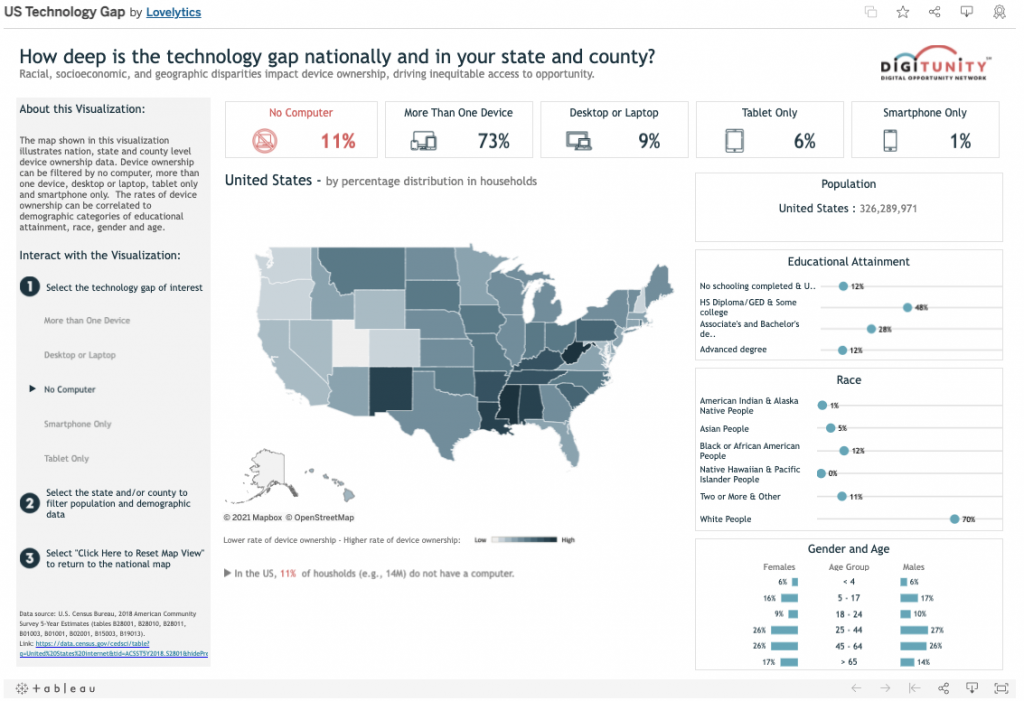
The Technology Gap Map™ is designed to educate people and help them understand the impact of the technology gap on marginalized, vulnerable people in their states, cities, and neighborhoods.
By Channing Nesbitt, Co-Lead, Tableau Foundation’s Racial Justice Data Initiative | October 15, 2021
In the work to close the digital divide in the U.S., Digitunity’s Technology Gap MapTM has become a powerful visualization of the racial, socioeconomic, and geographic disparities impacting device ownership and driving inequitable access to opportunity. With the help of Racial Equity Data Hub advisors Chantilly Jaggernauth from Lovelytics, and Allen Hillery, the map utilizes cutting-edge data and visualization solutions in Tableau to personalize the breadth and depth of the technology gap, while exploring questions regarding digital inequity.
As an educator both trained and at heart, Karisa Tashjian, Director of Programs for Digitunity, combined her early career work with adult immigrants learning English with the power of technology. Together, they toiled in a library basement. The newly arrived with little knowledge of English and computers to create vibrant slide presentations about things they love, birthday cards for their children, and even résumés. At the time, many said technology skills were “nice to have” rather than a tremendous door to opportunity.
Digitunity’s network of digital inclusion practitioners are working to scale digital equity for all.
Digitunity, an initiative of the National Cristina Foundation, is a national organization working to eliminate the technology gap and build inclusive device ownership so everyone can thrive in a digitally-connected society. The organization’s holistic approach encompasses skill development, enabling people to lead independent, productive, and meaningful lives.
Through their Digital Opportunity Network, collaborations with national stakeholders ensure everyone who needs a computer has one. This work includes connectivity and the skills to use devices productively. It requires the continuous development of partnerships and sustainable pathways to device ownership and digital equity for today and the future.
“Through my work at a public library in a majority-minority city, I repeatedly saw the stark impact that lack of computer and digital literacy skills has on one’s opportunities, and I saw what having access could bring,” Karisa said. “As I transitioned to my work at Digitunity, I was compelled to reach out to Tableau to leverage the use of data to expose the technology gap through creation of the Technology Gap Map.”
Closing the digital equity gap is not a one time process, but rather a continual effort that requires communities to understand both their needs and the opportunities for growth. Unsurprisingly, data itself can play a significant role in guiding that process.
The Technology Gap Map™ Possibilities
Digitunity developed the Technology Gap MapTM to provide a granular snapshot of the lack of household access to computers, and to help identify challenges and potential opportunities for digital inclusion solutions. In helping people understand the impact of the technology gap on marginalized and vulnerable people in their area, they can be inspired to take action and help close the technology gap for all.
“Through my work at a public library in a majority-minority city, I repeatedly saw the stark impact that lack of computer and digital literacy skills has on one’s opportunities, and I saw what having access could bring,” Karisa said. “As I transitioned to my work at Digitunity, I was compelled to reach out to Tableau to leverage the use of data to expose the technology gap through creation of the Technology Gap Map.”
Closing the digital equity gap is not a one time process, but rather a continual effort that requires communities to understand both their needs and the opportunities for growth. Unsurprisingly, data itself can play a significant role in guiding that process.
It is Digitunity’s belief that a fully-enhanced and evolved Technology Gap Map will inform decision-making on the most impactful strategies to support digital equity, hone in on the ways in which digital and racial equity intersect, and encourage companies to look to Digitunity’s Digital Opportunity Network for redirecting lightly-used hardware into the hands of the marginalized people who can benefit from access to this technology.
Digitunity’s Vision to Close the Technology Gap
When Digitunity started this project, they viewed their work as a catalyst for identifying and unlocking opportunities that include connectivity to community relationships, the pursuit of future employment, access to social and health services, and strengthening intergenerational family bonds. The benefits of their critical work apply to both non-deviced and under-deviced households because Digitunity believes device ownership is at the heart of digital equity and the gateway to opportunity for all. The map sheds light on the millions of people cut off from equitable opportunity because they don’t have enough computers and lack sufficient broadband infrastructure.
When the lack of a computer locks a child out of school, that sets these children on a different trajectory than their peers and creates a critical knowledge gap. When an unemployed person lacks the computer they need to gain digital skills and compete for a better job, that’s an opportunity gap. It’s a health and wellness gap when lack of a computer prevents access to tele-healthcare and online patient portals, especially for older adults or in rural and remote areas.
The Technology Gap Map™ is designed to educate people and help them understand the impact of the technology gap on marginalized and vulnerable people in their states, cities, and neighborhoods.
This point is something Amy Gonzales, associate professor in the Department of Communication at the University of California, Santa Barbara, has seen in her own work. Studying the effects of social interaction via communication technologies on individual identity, social support, and well-being and the consequences of disrupted access to communication technology, she has noted that holistic support that seeks out answers to compensate for frequent periods of technology disconnection (dependable instability) must be instituted by social services and health providers, to positively impact the lives of marginalized people.
When continually tracking the status of digital equity, resources like the map become a type of thermometer, monitoring the temperature of equitable access to digital resources and alerting entire communities of when and where there is more work to be done. This data communicates and educates individuals, government, philanthropy, researchers, and the business community about contributing to solutions, spurring all to play their part in taking action. To find out more about the role of data in closing the digital divide, visit the Tableau Foundation’s Racial Equity Data Hub.