UAM-CTM Launches Digital Literacy Program to Expand Computer Ownership in Southeast Arkansas

On January 21, the University of Arkansas at Monticello College of Technology–McGehee (UAM-CTM) and the UAM Adult Education Center officially launched the UAM Digital Literacy Program, a new initiative designed to expand computer access and strengthen digital skills for adult learners across southeast Arkansas.

The program is part of the 3 Southern States Connected Communities Program, a regional effort led by Digitunity and AT&T to address persistent technology barriers in underserved and rural communities. Through this initiative, students gain access to refurbished laptops paired with digital skills training, recognizing that meaningful opportunity today depends on both devices and the ability to use them effectively.

From Digital Skills to Computer Ownership

Through the UAM-CTM program, adult education students who complete a digital skills workshop along with WAGE I and WAGE II employability courses receive a refurbished laptop to support their continued learning and workforce goals. Students enrolled in the Business Office Technology and Health Information Technology programs may check out laptops during their studies, and keep them upon graduation.

In total, 250 refurbished laptops will be distributed to students through this initiative.

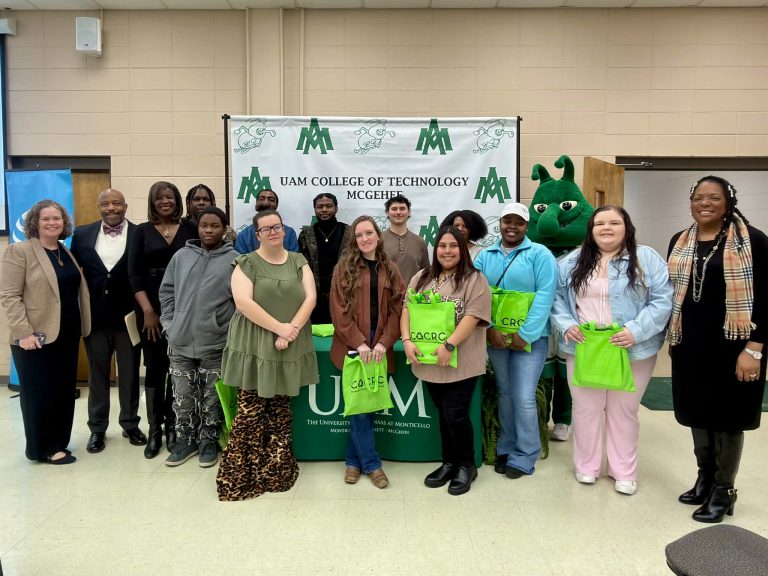
Prior to receiving a device, all participating students complete Connected Learning digital literacy workshops covering topics such as computer use, internet safety, and essential internet skills. The launch event featured recorded testimonials from adult education students describing how laptop ownership will enable them to access coursework, complete assignments, and pursue employment opportunities. Following completion of the prerequisite training, 11 adult education students received their personal laptops.

Group of students and staff posing indoors in front of a UAM College of Technology–McGehee banner and table display, several holding bright green tote bags, with a green school mascot standing behind them.

The laptops distributed through the program were refurbished by the Capital Area Corporate Recycling Council (CACRC) in Baton Rouge, Louisiana. Through CACRC’s work refurbishing donated equipment from Digitunity’s national network, devices are given a second life, supporting both environmental responsibility and educational opportunity.

By providing this behind-the-scenes infrastructure, learners who might otherwise not be able to own a computer are able to do so.

A Collaborative Approach

The launch event brought together leaders from higher education, workforce development, state broadband, and local government, including representatives from the University of Arkansas at Monticello, Arkansas Workforce Connections, the Arkansas State Broadband Office, the City of McGehee, and the Arkansas congressional delegation.

UAM-CTM Vice Chancellor Steven Jossell emphasized the importance of long-term collaboration in addressing digital access challenges:

“We gather here because we share a common conviction: that access to opportunity should never be dictated by one’s zip code, income level, or circumstances. In today’s world, opportunity is inextricably linked to digital access and digital fluency.” “Addressing this challenge requires more than isolated efforts; it demands bold, intentional, and enduring partnerships—precisely like the one we celebrate today.”

Lisa Lake, AT&T’s Vice President of External & Legislative Affairs, stated that the company’s dedication to improving digital access and fostering skills development is a long-standing commitment:

“At AT&T, we believe every person deserves the same shot at success, regardless of zip code, background, or income level. That’s why we launched AT&T Connected Learning—a $5 billion commitment through 2030 focused on connectivity, digital literacy, and digital learning.”

Building Pathways to Opportunity

This initiative represents a meaningful step toward increasing educational access, strengthening workforce readiness, and supporting long-term economic growth across southeast Arkansas. By pairing computer ownership with digital skills training, and anchoring the work in strong local and national partnerships, UAM-CTM, Digitunity, and AT&T are helping ensure that students have the tools they need to learn, work, and participate fully in today’s digital world.

Learn more about the 3 Southern States Connected Communities Program and how this regional effort is supporting communities across Arkansas, Louisianna and Mississippi or make a donation to support this work.


Other Recent Posts

Black-and-white portrait of a woman wearing a cowboy hat, patterned glasses, and a light-colored jacket while smiling and adjusting the brim of her hat indoors.

Lifelong Learner: Ms. Gales’ Digital Journey

Ms. Brenda Gales spent decades teaching kindergartners how to learn. In retirement, she found that she was now the learner as the digital world continuously moves ahead. Laptops, unfamiliar interfaces, complex software: she manages her iPhone well, but other technologies started feeling out of reach. When a former classmate from high school told her about the Connected Learning digital literacy workshops offered by Canopy Children’s Solutions in collaboration with Digitunity and AT&T, Ms. Gales didn’t

Graphic promoting a Digitunity report titled “AI Workforce Investments Risk Falling Short Without Computer Ownership.” The image shows the report cover alongside the text “Download the Report” and states that more than 32.9 million Americans lack a computer at home, limiting participation in AI-driven education and workforce programs.

New Report: AI Workforce Investments Risk Falling Short Without Computer Ownership

A new analysis on why policy momentum requires stronger implementation systems We believe the nation’s ability to compete in an AI-driven economy depends on building skills at scale. Federal agencies, state leaders, and workforce systems are moving quickly to expand AI education and training. While policy momentum is clear, the underlying infrastructure necessary for implementation has failed to keep pace. AI literacy is not achieved through a single session or a short-term course; it requires

Hand on a steering wheel driving down an open highway through a desert landscape with mountains in the distance.

How Philanthropy Can Fund Truly Inclusive AI

Scot Henley Executive Director at Digitunity “Inclusive AI” is everywhere in philanthropy right now. I want to talk about what it actually means, and what funders are missing. First, let’s state what is true and obvious. Major philanthropic funders play a vital role in society, deploying vast resources to address problems large and small, at home and abroad. As the adoption and capability of AI races forward at breathtaking speed, philanthropy has mobilized to tackle

Translate »

The need for computers has never been greater.​ Sign up for our newsletter.