In Digitunity's new report, we uncover who is most affected by the computer ownership gap - and why smartphones alone are not enough.
A limited amount of public data focuses only on large-screen computer ownership. Most national data combines computer and internet access, making it difficult to determine the actual need for computers.
This report analyzes previously unpublished Census data on people who either have no computer at all or rely only on a smartphone for internet access. Together, these two groups make up Digitunity’s measure of “large-screen computer ownership.”
According to the 2023 American Community Survey, 1 in 7 U.S. households falls into one of these categories. Using the Census Bureau’s Microdata Access Tool (MDAT), the authors created custom datasets that break down the data by age, education, employment status, and race/ethnicity to illustrate how computer access varies across different groups.
The analysis also compares 2016 to 2023, showing a clear shift: households without any computers have declined, but reliance on smartphones has grown. Large differences remain among states, often tied to underlying demographic and economic factors.
Who does not have a large-screen computer?
- Older adults: In 2023, nearly one in five adults older adults do not have a large-screen computer at home. They are five times more likely than working-age adults to lack any computing device, and one in ten relies only on a smartphone to get online. These statistics have declined from 2016 when 1 in 4 older adults did not have a large-screen computer (24.6%)
- Education level: About one in three adults without a high school diploma lacks a large-screen computer at home. One in five (20.5%) rely solely on smartphones, compared to just 2.4% of those with a college degree or higher.
- Race and ethnicity: One in four residents who identify as “some other race,” and about one in six African American, American Indian/Alaska Native, and Native Hawaiian/Other Pacific Islander residents lack a large-screen computer. By contrast, the rates are 5.5% for Asian Americans and 8.5% for white, not Hispanic or Latino residents.
- Employment status: People without a job are more than four times as likely to be without any type of computing device as those who are employed (5.6% vs. 1.2%). One in ten unemployed individuals relied solely on a smartphone to access the internet.
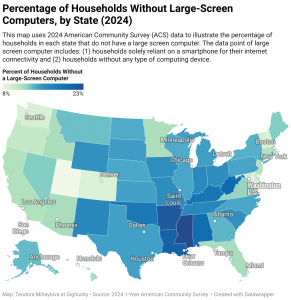
- Geography: Disparities are stark across states. A household in Mississippi is three times more likely to lack a large-screen computer than a household in Utah.
The report’s literature review establishes a clear association between computer ownership and better educational and employment outcomes, including higher weekly employment rates, higher wages, and increased digital skills.
Author Perspectives
Brian Whitacre, Ph.D., Professor and Jean & Patsy Neustadt Chair, Oklahoma State University
“An important takeaway from the report is that the number of households relying solely on smartphones for their internet connectivity has increased dramatically since 2016. However, there are notable differences across age/race / educational attainment/employment status that should be considered for targeted efforts to increase large screen ownership.”
Teodora Mihaylova, Project Manager, Digitunity
“The digital divide is a multifaceted phenomenon, and understanding the nuances of computer access gaps across socio-demographic characteristics and geography can inform public policy at the local, state, and national levels. The finding that 1 in 7 households or 33.2 million residents, don’t have access to large-screen computers is striking. These individuals are left behind in the digital age, facing disadvantages in educational and employment opportunities, access to telehealth, government services, skills, and information. Importantly, the report seeks to understand the reasons behind these disparities, which are mostly rooted in socio-demographic and household income levels differences. ”
FAQ
How does this report data (2023) differ from the most recent release of the 2024 estimates?
The numbers are very similar. In 2023, about 18 million U.S. households (13.75%) lacked a large-screen computer. In 2024, that number dropped slightly to 17.7 million households (13.31%).
State-level differences also narrowed a bit, ranging from 8.2% to 24.2% in 2023 and 7.5% to 22.8% in 2024. All states saw small improvements, except for 8 states that had slight increases in the share of households without large-screen computers between 2023 and 2024. Notably, the share of households in Puerto Rico without a large-screen computer rose from 39.5% in 2023 to 43.4% in 2024. Wyoming’s share of households without devices increased from 13% in 2023 to 15.2% in 2024. Alaska, Idaho, and Maine experienced an approximately 1% increase in households without large-screen computers between 2023 and 2024. To explore our in-depth analysis of the 2023 ACS estimate, click here, and to read our 2024 analysis, click here.
Why focus on large-screen computers instead of smartphones?
Smartphones are valuable devices, but they can’t fully support critical activities such as applying for jobs or accessing telehealth services and government benefits. Individuals who rely on smartphones have a more limited experience of the internet and a narrower set of digital skills compared to those who use computers. Watch our 2025 interview with Dr. Amy Gonzales, UCSB, on why computers matter.
How should states, communities, or funders use this report?
The findings provide evidence to inform the design of policies and programs that address the widest gaps in computer access. State leaders, funders, and community organizations can utilize the data to inform their investments, prioritize resources, and develop stronger local systems.
Where can I access the full dataset?
The full report and appendices include references to data sources from the Census Bureau. Custom tables were created using the Census Microdata Access Tool (MDAT), and links are provided in the report for those who wish to explore the data further.
Explore Similar
In September 2025, the U.S. Census Bureau released the 2024 American Community Survey (ACS) data offering insights of important national and state-level digital…

The digital divide in the United States is substantial, with 1 in 7 households either lacking access to any type of computing device or relying solely on a smartphone for their internet connectivity…