In September 2025, the U.S. Census Bureau released the 2024 American Community Survey (ACS) data offering insights of important national and state-level digital divide trends. Digitunity identified and analyzed two data points illustrating the (1) number of households without any type of computing device and (2) households that rely solely on a smartphone to go online. Together, these data points yield the statistic we call households without a large screen computer.
The National Snapshot: 17.7 Million Households Without Large-Screen Computers
In 2024,
- 1 in 7.5 households in the United States do not have a large screen computer.
- There are 17.7 million households, including:
- 13,195,205 households solely reliant on a smartphone for their internet
- 4,506,213 households without any type of computing device
- These 13.3% U.S. households do not have any type of computing device or rely only on a smartphone to access the internet
State-Level Variability in Computer Ownership
Digitunity’s analysis shows that there is considerable variability between states in terms of the depth of the digital divide and the range of households without a large screen computer is between less than 8% to approximately 23%. The 2024 ACS data analyzed here includes information for all fifty states, the District of Columbia, and Puerto Rico.
The states with the highest levels of households without a large-screen computer in 2024 are:
- Mississippi (22.8%)
- Arkansas (21.7%)
- Louisiana (21.1%)
- West Virginia (19.8%)
- Kentucky (18.5%)
The states with the lowest levels of households without a large-screen computer in 2024 are:
- Utah (7.5%)
- Colorado (8.8%)
- District of Columbia (8.9%) and New Hampshire (8.9%)
- Washington (9%)
- Vermont (9.2%)
This variability means that a household in Arkansas, Louisiana, and Mississippi is approximately three times more likely to not have a large screen computer than one in Utah. Puerto Rico, not pictured in the map, is experiencing the nation’s worst digital divide, where 539,000 million households or about 43.4% of all households do not have a large screen computer.
Trends Over Time: 2016 - 2024 Reliance on Smartphones
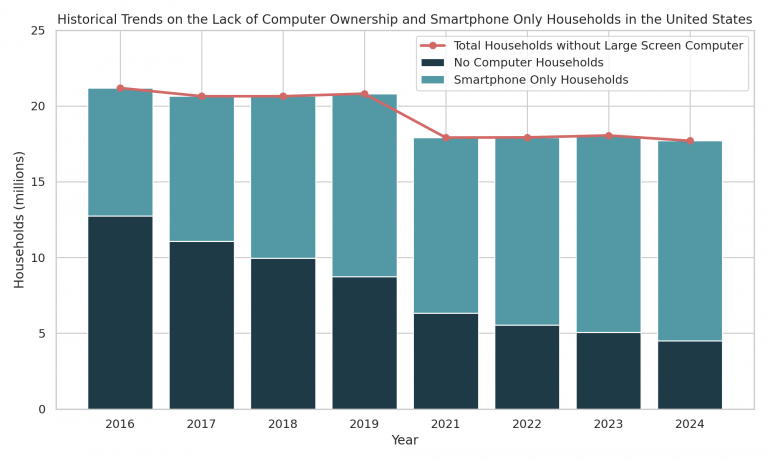
Digitunity’s analysis shows a shift in how we access the internet. Since 2016, an increasing number of households are relying on smartphones to connect to the internet, and fewer households have a computer such as a desktop, laptop or tablet to go online.
Lack of Computer / Smartphone Only Access in the United States 2016-2024
Source: U.S. Census Bureau. "Types Of Computers and Internet Subscriptions ." 2024 American Community Survey, ACS 1-Year Estimates Subject Tables, Table S2801
While progress is being made on increasing computer ownership, the overall need for large-screen computers remains significant, affecting more than 17.7 million households in 2024. The national need for large-screen computers has held steady over the past four years.
Between 2021 and 2024, the total number of households without large-screen computers has fallen by only 1.2 percentage points or about 212,000 households.
Why Large-Screen Computers Still Matter?
Everyday tasks such as completing job applications, pursuing online education, and accessing government services are difficult to complete without access to a large-screen computer. Smartphones aren’t sufficient. The Federal Emergency Management Agency (FEMA) recently instituted a new requirement for applicants seeking government assistance after a natural disaster to have an email address to register for aid. The Social Security Administration (SSA) is increasingly transitioning to online services requiring applicants to create an account to apply and manage their benefits, and each user is required to have a personal email address.
These national and state level snapshots do not tell the whole story. They miss the depth of the problem for historically marginalized communities and do not capture the regional variability of the digital divide within states. Urban households are more likely to have a large screen-computer compared to rural ones.
Rural vs. Urban Computer Ownership Gaps
In 2024,
- 12.4% of urban households do not have a large-screen computer
- 9.4% had access only to a smartphone to go online
- 3% did not have any type of computing device
- 16.8% of rural households do not have a large-screen computer
- 11.9% relied only to a smartphone to access the internet
- 4.9% did not have any type of computing device
In sum, rural households are 4.4% less likely to have access to a large-screen computer than urban ones. These statistics do not capture the full need for computers because they overlook under-deviced households where only one device is available for multiple users looking to go online.
This October, Digitunity will release new, previously unpublished research and an in-depth analysis exploring how socio-demographic characteristics including an individual’s age, race and ethnicity, educational attainment, and employment status relate to large-screen computer ownership. The report presents concrete strategies for achieving universal computer ownership, introduces Digitunity’s systems-level approach to address persistent barriers, and proposes local and national actions to help address this societal challenge.