Digital Navigators and the Device Divide: Community Voices from Seven U.S. Cities

Download Maribel Martinez Report Digital Navigators and the Device Divide- Community Voices from Seven U.S. Cities

How can government policy handle digital inequalities?

Digital Navigators are playing a crucial role in the post-pandemic landscape in the United States, where there is growing interest in bridging the digital divide. They support their communities by participating in activities such as digital navigation training—specialized skills training focused on strategies that help individuals access affordable home broadband, obtain large-screen computers like laptops and tablets, and develop both foundational and advanced digital skills. These efforts enable more people to fully engage in today’s connected world.

The demand for computers and tablets became even more urgent with the onset of the COVID-19 pandemic. The crisis highlighted the essential need for large-screen devices, along with the digital skills necessary for individuals of all ages to work, learn, access healthcare, and secure other essential services.

This small-scale qualitative research study explores the experiences of Digital Navigators in their efforts to help people with limited resources acquire computers. It examines the challenges they face in securing affordable large-screen devices and provides insights on how to improve the overall process of making technology more accessible.

Fill out the form below to receive a complimentary copy of the full report. 

Download the Digital Inequalities, E-Waste, & Right-to-Repair Report
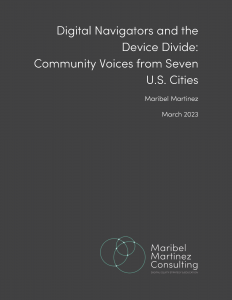
Cover image of the report: Digital Navigators and the Device Divide- Community Voices from Seven U.S. Cities 

Other Recent Posts

A man wearing a maroon polo shirt and an "Oklahoma" baseball cap sits at a wooden desk using a computer with a spreadsheet open on it.

Digital Skills in Action: From Training to the Workplace

At Hope House Guthrie, rebuilding a life often begins with learning new skills. Hope House Guthrie is a nonprofit in Guthrie, Oklahoma, that provides shelter, meals, and clothing to individuals experiencing homelessness and hardship. The organization also connects people to resources that support recovery, employment, and long-term stability. For many people entering recovery and life transformation programs, rebuilding their lives means gaining work experience, reconnecting with their community, and learning ways to navigate systems that

Cover image of Digitunity report on smartphone-only access and its limits in program design and policy.

The Smartphone-Only Assumption

Why device access shapes participation in modern systems A new analysis from Digitunity examines a common assumption in program design and policy: that smartphone access is enough. This analysis shows where that assumption breaks down. While smartphones are widely used and effective for communication and quick tasks, they are not designed for the kinds of activities required to fully participate in modern systems, such as education, employment, healthcare, and public services. In the United States,

A man stands in front of a green CACRC backdrop, holding an open laptop and smiling, dressed in a black polo and sneakers.

How One Louisiana Nonprofit is Strengthening Computer Ownership Across the Gulf South

In Louisiana, a non-profit technology refurbisher addresses an overlooked digital divide by giving computers a second life and a second home. The computer ownership gap across Arkansas, Louisiana, and Mississippi is among the deepest in the nation. In these Southern states, 2024 American Community Survey data shows that 1 in 5 households or a total of 929,620 households, did not have access to a computer or relied solely on a smartphone for their internet connectivity.

Translate »

The need for computers has never been greater.​ Sign up for our newsletter.