Millions Still Left Behind: The Reality of America’s Digital Device Divide

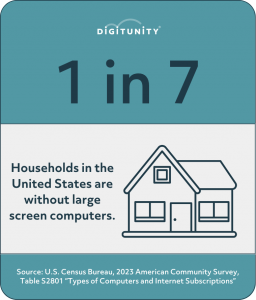
Did you know that 1 in 7 households in the United States still don’t have access to a large-screen computer?

In today’s digital world, the internet is critical to how we access job applications, make medical appointments, file taxes and learn. The digital divide is a major barrier to opportunity. We have published two interactive maps which paint a clear picture of how the digital divide is still affecting millions of people across the country.


Infographic stating 1 in 7 U.S. households lack large screen computers, with a house icon and source citation from the U.S. Census Bureau.

The Numbers Behind the Divide

According to 2023 data from the American Community Survey, more than 18 million households in the U.S. either rely solely on smartphones for internet access or don’t own any type of computing device. That’s about 33.2 million people navigating a digitally connected world with limited or no access to the tools many of us take for granted.

The disparities are even more stark in certain parts of the country. In states like Mississippi, West Virginia, Arkansas, and Louisiana, nearly 1 in 4 households are without a large-screen computer. States like Alabama, Kentucky, and Oklahoma aren’t far behind, with close to 1 in 5 households facing the same issue.

And in Puerto Rico, the need is most urgent: about 40% of households either have no computer at all or depend solely on a smartphone to get online.


Why Are Large-Screen Devices a Necessity?

Research shows that access to a large-screen computer expands what people can do online. These devices are essential for what experts call “beneficial internet use,” which include:

  • Conducting job searches and completing applications
  • Accessing government services like voter registration or driver’s license renewal
  • Using telehealth platforms to connect with healthcare providers
  • Managing personal health records and researching medical information

The impact is measurable. A 2024 study found that veterans who received a tablet from the Veterans Health Administration were three times more likely to have a telehealth appointment than those who didn’t. Owning a connected device didn’t just make participation easier—it helped ensure more veterans actually received the care they needed.

The educational stakes are just as high. One study showed that students with access to home computers were 6–8% more likely to graduate high school than classmates without devices. Meanwhile, students without internet-enabled devices at home faced academic setbacks equivalent to 7–14 months of learning loss and had lower GPAs.

Fortunately, states are making progress in closing the digital divide. In Colorado, Idaho, New Hampshire, Utah, and Washington, fewer than 10% of households are without access to a large-screen computer, showing that progress is possible.


A Tool for Change

Digitunity’s new interactive maps do more than highlight the problem—they’re designed to be a practical tool for local leaders, policymakers, and community organizations. Building on the 2022 Tech Gap Map, the two interactive maps allow users to hover over each state to see:

  • How many households are affected
  • The percentage of households without large-screen computers
  • Where targeted digital inclusion efforts are most needed

This resource is part of Digitunity’s broader mission to close the digital divide by making computer ownership accessible to all.


Explore the Maps

Do you want to see how your state stacks up? Curious about where help is most needed? Explore the two interactive maps and dig into the data yourself.

Digitunity is a national nonprofit organization with a mission to make owning a computer possible for everyone. Engaged in advancing digital opportunity for nearly forty years, Digitunity generates and places donated computers with organizations serving people in need, supports a national practitioner network, and advises states, cities, and coalitions on strategies to meet the ongoing device needs of people impacted by the digital divide.

Other Recent Posts

New Report: AI Workforce Investments Risk Falling Short Without Computer Ownership

A new analysis on why policy momentum requires stronger implementation systems We believe the nation’s ability to compete in an AI-driven economy depends on building skills at scale. Federal agencies, state leaders, and workforce systems are moving quickly to expand AI education and training. While policy momentum is clear, the underlying infrastructure necessary for implementation has failed to keep pace. AI literacy is not achieved through a single session or a short-term course; it requires

Hand on a steering wheel driving down an open highway through a desert landscape with mountains in the distance.

How Philanthropy Can Fund Truly Inclusive AI

Scot Henley Executive Director at Digitunity “Inclusive AI” is everywhere in philanthropy right now. I want to talk about what it actually means, and what funders are missing. First, let’s state what is true and obvious. Major philanthropic funders play a vital role in society, deploying vast resources to address problems large and small, at home and abroad. As the adoption and capability of AI races forward at breathtaking speed, philanthropy has mobilized to tackle

A man wearing a maroon polo shirt and an "Oklahoma" baseball cap sits at a wooden desk using a computer with a spreadsheet open on it.

Digital Skills in Action: From Training to the Workplace

At Hope House Guthrie, rebuilding a life often begins with learning new skills. Hope House Guthrie is a nonprofit in Guthrie, Oklahoma, that provides shelter, meals, and clothing to individuals experiencing homelessness and hardship. The organization also connects people to resources that support recovery, employment, and long-term stability. For many people entering recovery and life transformation programs, rebuilding their lives means gaining work experience, reconnecting with their community, and learning ways to navigate systems that

Translate »

The need for computers has never been greater.​ Sign up for our newsletter.