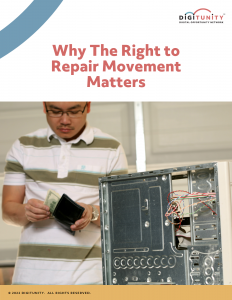
Why The Right to Repair Movement Matters

right to repair movement

The right to repair movement is made up of a diverse group of advocates.

What is the Right to Repair Movement?

Right to repair is a movement dedicated to safeguarding the right of consumers to repair their devices, whether personally or with the help of a trusted technician. Repair is legal under copyright law as determined by the US Copyright Office.

However, tech manufacturers use a variety of techniques to prevent repair outside their control. These include denying access to parts and manuals and threatening consumers over their warranties, which is considered a violation of federal warranty law.

Right to repair advocates hope to pass legislation to ensure consumers can fix devices. This resource provides information about the right to repair movement and how it impacts people and the environmentRegister below. Then, click the download button to receive this resource.

Download Why The Right to Repair Movement Matters
right to repair movement resource

Other Recent Posts

A man wearing a maroon polo shirt and an "Oklahoma" baseball cap sits at a wooden desk using a computer with a spreadsheet open on it.

Digital Skills in Action: From Training to the Workplace

At Hope House Guthrie, rebuilding a life often begins with learning new skills. Hope House Guthrie is a nonprofit in Guthrie, Oklahoma, that provides shelter, meals, and clothing to individuals experiencing homelessness and hardship. The organization also connects people to resources that support recovery, employment, and long-term stability. For many people entering recovery and life transformation programs, rebuilding their lives means gaining work experience, reconnecting with their community, and learning ways to navigate systems that

Cover image of Digitunity report on smartphone-only access and its limits in program design and policy.

The Smartphone-Only Assumption

Why device access shapes participation in modern systems A new analysis from Digitunity examines a common assumption in program design and policy: that smartphone access is enough. This analysis shows where that assumption breaks down. While smartphones are widely used and effective for communication and quick tasks, they are not designed for the kinds of activities required to fully participate in modern systems, such as education, employment, healthcare, and public services. In the United States,

A man stands in front of a green CACRC backdrop, holding an open laptop and smiling, dressed in a black polo and sneakers.

How One Louisiana Nonprofit is Strengthening Computer Ownership Across the Gulf South

In Louisiana, a non-profit technology refurbisher addresses an overlooked digital divide by giving computers a second life and a second home. The computer ownership gap across Arkansas, Louisiana, and Mississippi is among the deepest in the nation. In these Southern states, 2024 American Community Survey data shows that 1 in 5 households or a total of 929,620 households, did not have access to a computer or relied solely on a smartphone for their internet connectivity.

Translate »

The need for computers has never been greater.​ Sign up for our newsletter.