Rural Arizona and Community Voices: What We Can Learn about Expanding Computer Ownership

Tens of thousands of Arizona households struggle every day without access to a personal computer, making do with smartphones or limited public access to access the world. In some rural towns, as many as one in three homes do not have access to a large-screen computer, disconnecting families from valuable opportunities in education, employment, health, and citizenship.

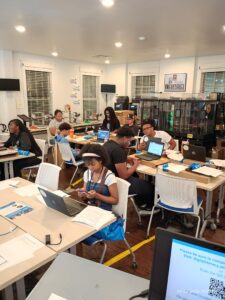
Digitunity’s newest case study, developed in partnership with Chicanos Por La Causa and supported by AT&T, explores this issue in depth. Through focus groups, field data, and a device deployment initiative in San Luis and Miami, the report documents the real barriers residents face and the community-driven solutions emerging in response.

What we learned supports the reality we’ve observed in communities through our extensive rural work. By collaborating, local institutions, public institutions, and residents can create the infrastructure and support needed to make it possible for everyone to own a computer.
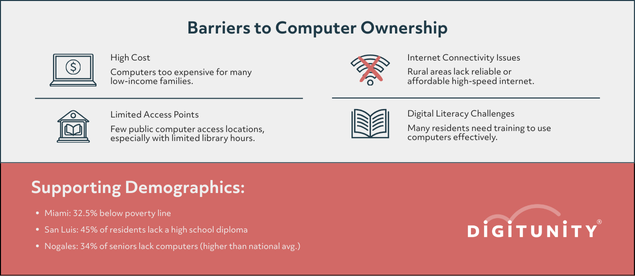
Infographic showing barriers to computer ownership: high cost, limited access points, unreliable internet, and lack of digital skills. Includes supporting demographic statistics.

The case study reveals:

  • Personal experiences of those living daily life without an individual computer
  • Statistics regarding computer ownership disparities in cities such as Superior, Nogales, San Luis, and Miami
  • The contribution of credible local institutions to supporting training, access, and sustained use
  • Actionable strategies that can inform other rural digital access initiatives

This report draws on Digitunity’s broader rural initiatives, including our recent Mississippi Case Study, and Rural Communities & Digital Device Ownership, a 2022 report authored by Dr. Brian Whitacre. A follow-up to that report is currently in development and expected to be released in the coming months. Collectively, these efforts deepen our understanding of what’s required to advance locally grounded approaches to expanding access to technology where the need is greatest.

Digitunity is a national nonprofit organization with a mission to make owning a computer possible for everyone. Engaged in advancing digital opportunity for over 40 years, Digitunity generates and places donated computers with organizations serving people in need, supports a national practitioner network, and advises states, cities, and coalitions on strategies to meet the ongoing device needs of people impacted by the digital divide.

Other Recent Posts

A man wearing a maroon polo shirt and an "Oklahoma" baseball cap sits at a wooden desk using a computer with a spreadsheet open on it.

Digital Skills in Action: From Training to the Workplace

At Hope House Guthrie, rebuilding a life often begins with learning new skills. Hope House Guthrie is a nonprofit in Guthrie, Oklahoma, that provides shelter, meals, and clothing to individuals experiencing homelessness and hardship. The organization also connects people to resources that support recovery, employment, and long-term stability. For many people entering recovery and life transformation programs, rebuilding their lives means gaining work experience, reconnecting with their community, and learning ways to navigate systems that

Cover image of Digitunity report on smartphone-only access and its limits in program design and policy.

The Smartphone-Only Assumption

Why device access shapes participation in modern systems A new analysis from Digitunity examines a common assumption in program design and policy: that smartphone access is enough. This analysis shows where that assumption breaks down. While smartphones are widely used and effective for communication and quick tasks, they are not designed for the kinds of activities required to fully participate in modern systems, such as education, employment, healthcare, and public services. In the United States,

A man stands in front of a green CACRC backdrop, holding an open laptop and smiling, dressed in a black polo and sneakers.

How One Louisiana Nonprofit is Strengthening Computer Ownership Across the Gulf South

In Louisiana, a non-profit technology refurbisher addresses an overlooked digital divide by giving computers a second life and a second home. The computer ownership gap across Arkansas, Louisiana, and Mississippi is among the deepest in the nation. In these Southern states, 2024 American Community Survey data shows that 1 in 5 households or a total of 929,620 households, did not have access to a computer or relied solely on a smartphone for their internet connectivity.

Translate »

The need for computers has never been greater.​ Sign up for our newsletter.