Digital Inequalities, E-Waste, & Right-to Repair

Digital Inequalities Photo

Digital inequalities, e-Waste, and Right-to-Repair are three policy sectors informing device access.

How can government policy handle computer ownership?

Though the government has long played a key role in promoting internet and computing access, a review of U.S. and international legislation reveals an emphasis on internet access over other factors necessary for holistic digital connectedness, such as device access and digital skills training. 

Digitunity commissioned leading expert Amy Gonzales, an Associate Professor of the Department of Communication at the University of California, Santa Barbara, to highlight government legislation from around the globe that primarily informs personal ownership of computing devices.

This original report provides information to identify policies that practitioners, researchers, policy makers, and other digital opportunity practitioners might target to optimize computer access over the coming decades. Register below. Then, click the download button to receive a PDF copy of the report.

Download the Digital Inequalities, E-Waste, & Right-to Repair Report
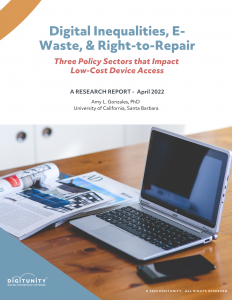
An open laptop on a desk next to papers and shelves; overlaid text shows a research report on digital inequalities, e-waste, and right-to-repair by Amy L. Gonzales, April 2022.

Other Recent Posts

Hand on a steering wheel driving down an open highway through a desert landscape with mountains in the distance.

How Philanthropy Can Fund Truly Inclusive AI

Scot Henley Executive Director at Digitunity “Inclusive AI” is everywhere in philanthropy right now. I want to talk about what it actually means, and what funders are missing. First, let’s state what is true and obvious. Major philanthropic funders play a vital role in society, deploying vast resources to address problems large and small, at home and abroad. As the adoption and capability of AI races forward at breathtaking speed, philanthropy has mobilized to tackle

A man wearing a maroon polo shirt and an "Oklahoma" baseball cap sits at a wooden desk using a computer with a spreadsheet open on it.

Digital Skills in Action: From Training to the Workplace

At Hope House Guthrie, rebuilding a life often begins with learning new skills. Hope House Guthrie is a nonprofit in Guthrie, Oklahoma, that provides shelter, meals, and clothing to individuals experiencing homelessness and hardship. The organization also connects people to resources that support recovery, employment, and long-term stability. For many people entering recovery and life transformation programs, rebuilding their lives means gaining work experience, reconnecting with their community, and learning ways to navigate systems that

Cover image of Digitunity report on smartphone-only access and its limits in program design and policy.

The Smartphone-Only Assumption

Why device access shapes participation in modern systems A new analysis from Digitunity examines a common assumption in program design and policy: that smartphone access is enough. This analysis shows where that assumption breaks down. While smartphones are widely used and effective for communication and quick tasks, they are not designed for the kinds of activities required to fully participate in modern systems, such as education, employment, healthcare, and public services. In the United States,

Translate »

The need for computers has never been greater.​ Sign up for our newsletter.